
Wednesday, April 27, 2011
Walking buffalo bulls


Saturday, April 23, 2011
Heart breaking

The mother of the calf first had to sleep prior to darting the calf.

We took the opportunity to de-horn her to make her safer for the horrendous rhino poachers.
This little rhino calf I will remember forever. It was heart breaking to see him suffer so much. He was seen in good health, happily with his mother, just 2 days earlier. The game guards always try to check all our rhinos every day. Yesterday they were not found in the thick bush, which is not abnormal. But this morning they found the calf, severely distressed, dehydrated and paralysed in the hind legs. He was desperately trying to get up, but could not. The hot sun was not making things better either. I was terribly worried. His mother was standing next to him and an adult bull was waiting at around 20 meter distance. It seemed that the mother was defending her calf against attacks from this bull. Rhino bulls sometimes kill other rhinos, especially calves, and this bull was known to be aggressive. So our first thoughts were that trauma caused this acute paralysis. The prognosis of such a severe problem is poor, but of course we tried everything possible to save this calf. At first I had to immobilize the mother, as she would never allow us to come close to her fragile baby. After she fell asleep, I could dart the calf. It's important to always first wait until you are able to approach a wild animal before darting it. Dehydration, stress and myopathie (a muscle problem caused by prolonged stress, muscle strain and heat) made the anesthetics very dangerous.
Because I was worried that the calf might not survive the anesthetics, I used the lowest possible dosage of Etorphine: one drop. It worked well. The animal was asleep within 5 minutes. First thing I did was put a drip in both ears to administer as much fluid (Glucose 5% and Ringers) as possible. Then we took the opportunity to de-horn the mother to make sure that she was safe for poachers (horrible that this is necessary, but in the moment it's best for the animal).
Then we loaded the calf on the trailer to bring him to our hospital to be able to give the best possible treatment. We continued the drips during the hour journey to our quarantine facilities. The anesthetics (heart rate, breathing, blood pressure and oxygenation) were nice and steady. On top of glucose and Ringers IV, I gave a sedation to keep him calm, lots of different vitamins, minerals, antibiotics (meningitis was one of my differentials) and anti-inflammation/painkillers. With hay we made a nice soft bed for him to avoid any sores. When he was laying nicely, I gave the antidote for the etorphine. He survived the journey and anesthetics well, but the paralysis in his hind legs continued. Unfortunately the next morning he died. A very sad and frustrating case.

When the calf was asleep we put him on a stretcher to load him on a trailer.

After an hour journey we arrived at the quarantine facilities where we continued treating him.

Saturday, April 2, 2011


stripes
A question.... Are zebra's white with black stripes or black with white stripes?? 


In the uterus the foal is completely black at first and later the white stripes develop. So officially a zebra is black with white stripes. But in an adult zebra, the ground colour of the skin is white, also under the black stripes; this is seen when you shave the fur. So both answers are correct.
You see, grey is often the colour what answers complicated questions the best!


In the uterus the foal is completely black at first and later the white stripes develop. So officially a zebra is black with white stripes. But in an adult zebra, the ground colour of the skin is white, also under the black stripes; this is seen when you shave the fur. So both answers are correct.
You see, grey is often the colour what answers complicated questions the best!
Flying vet


 A helicopter and a skilled pilot (thanks Johan) are an amazing help with capturing wild buffalos. Suddenly you don't have to worry about tracking carefully in the bush to prevent the animals running away. On foot in the bush, you only get one chance and sometimes zero. Also a bad shot punishes you immediately, because sometimes we don't see the animal again for 2 weeks or so. From a helicopter the work is very different. When an animal runs off, it's fairly easy to find it again. After having darted around 3.500 wild animals on foot, horseback, a jeep and even a tree (waiting for hours and hours for one lucky shot), it was such a pleasure to dart from a helicopter. Because the terrain was open and the buffalos could see us from a long distance, it was impossible to approach the wild herd of buffalos within 50 meter or so. We had to catch the complete herd of 23 buffalos to move them to another area. Therefore we did not have another option than renting a helicopter and pilot. Luckily my boss agreed.
The darting (practise makes lucky!) and all anesthetics went very well. We took blood to test for Brucella, Corridor's disease and Foot and Mouth Disease and we did skin tests for Tuberculosis. These are the 4 'controlled diseases' in South Africa. African buffalos must be free of all these 4 diseases prior to getting a permit to leave an area (if they carry one of them, they can infect domestic cattle, which would be a disaster). All tests were negative, so I loaded all buffalos in a truck last week. The herd moved to their new home where they are roaming freely again!
A helicopter and a skilled pilot (thanks Johan) are an amazing help with capturing wild buffalos. Suddenly you don't have to worry about tracking carefully in the bush to prevent the animals running away. On foot in the bush, you only get one chance and sometimes zero. Also a bad shot punishes you immediately, because sometimes we don't see the animal again for 2 weeks or so. From a helicopter the work is very different. When an animal runs off, it's fairly easy to find it again. After having darted around 3.500 wild animals on foot, horseback, a jeep and even a tree (waiting for hours and hours for one lucky shot), it was such a pleasure to dart from a helicopter. Because the terrain was open and the buffalos could see us from a long distance, it was impossible to approach the wild herd of buffalos within 50 meter or so. We had to catch the complete herd of 23 buffalos to move them to another area. Therefore we did not have another option than renting a helicopter and pilot. Luckily my boss agreed.
The darting (practise makes lucky!) and all anesthetics went very well. We took blood to test for Brucella, Corridor's disease and Foot and Mouth Disease and we did skin tests for Tuberculosis. These are the 4 'controlled diseases' in South Africa. African buffalos must be free of all these 4 diseases prior to getting a permit to leave an area (if they carry one of them, they can infect domestic cattle, which would be a disaster). All tests were negative, so I loaded all buffalos in a truck last week. The herd moved to their new home where they are roaming freely again!
Friday, April 1, 2011
stitching up a sable bull


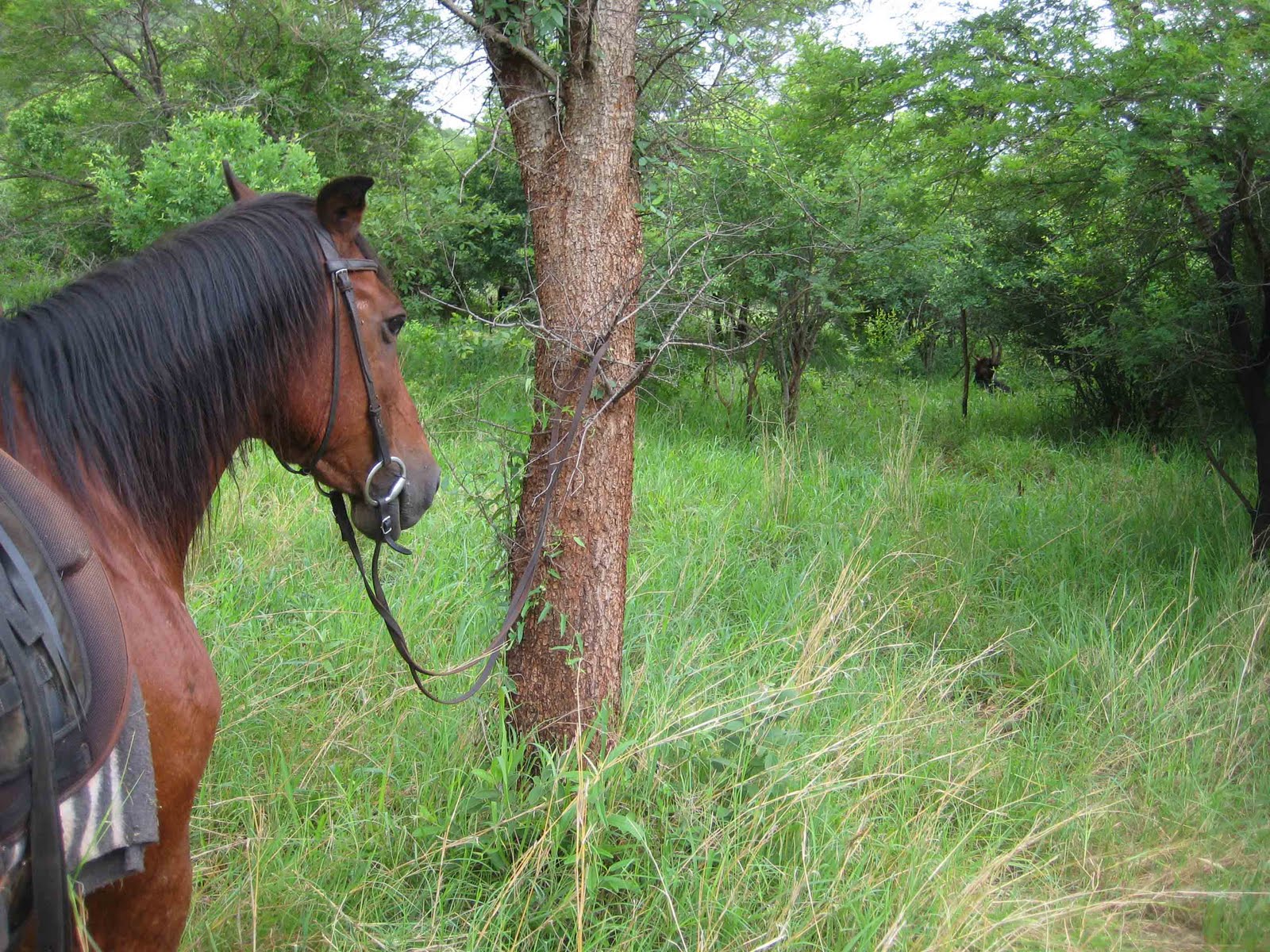
 This magnificent sable bull had a large wound just behind his left horn, likely caused by fighting with another bull. It was deep, dirty and full with maggots. I had to dart this animal to treat it as soon as possible! On horseback we could approach him at 30 meter distance and I was able to get a nice shot. He took off! With our horses we followed him through the bush, as it is important to get to a darted animal as quick as you can. It's not good to have a wild animal sleeping without supervision. A darted animal can fall wrong, regurgitate food from his stomach (what can be fatal) or have other complications. As a wildlife vet you want to be with the darted animal when it is sleepy but still standing, so that you are there immediately when it goes down. Of course this is not always possible in the bush, but we always try to find the animal as soon as we can. Therefore I never dart a wild animal without 2 horses and enough people to help looking for the animal. The good thing about darting sable antelopes is that they always make a weired crying sound when they are under anesthetics, which helps tremendously to find them in thick bush.
 This bull was luckily easy to find and he fell asleep under a tree, nice in the shade. The wound looked awful, but after cleaning it thoroughly, getting all the maggots out, refreshing the wound and stitching it up, it looked much better. Just before closing the wound, I filled the wound up with Acrisulph (the orange stuff on the pic), a miracle wound healing cream and antibiotics. I also put blue spray on the wound to keep flies away and gave an anti-parasite treatment, a painkiller and antibiotics by injection. I left a hole at the lowest point of the wound as a drainage to make sure that all dirt can get out, otherwise an abces can devellop. Then I woke him up and he wandered off as if nothing happened.
Within a few days, the wound was almost invisible. The healing capacity of wild animals is such a pleasure for vets.
This bull was luckily easy to find and he fell asleep under a tree, nice in the shade. The wound looked awful, but after cleaning it thoroughly, getting all the maggots out, refreshing the wound and stitching it up, it looked much better. Just before closing the wound, I filled the wound up with Acrisulph (the orange stuff on the pic), a miracle wound healing cream and antibiotics. I also put blue spray on the wound to keep flies away and gave an anti-parasite treatment, a painkiller and antibiotics by injection. I left a hole at the lowest point of the wound as a drainage to make sure that all dirt can get out, otherwise an abces can devellop. Then I woke him up and he wandered off as if nothing happened.
Within a few days, the wound was almost invisible. The healing capacity of wild animals is such a pleasure for vets.


 In memory of our wonderful colleague and friend Elmon Zitha. Thanks for the laughs, hard work and good times! We are missing you. May your spirit rest in peace.
Buffalo pedicure

 This handsome boy needed some help. He has been free-roaming in our park for quite some time, but because he was raised in a boma he prefers to hang around close to us (the bush is very scary and this big boy does not seem to realise how big he is). Therefore his hooves did not get worn off enough and we had to play 'the pedicure'. It was quite a big job, because the nails of an adult buffalo bull are made of tough material! We managed and now he's happily walking around on nicely trimmed feet again.
Thursday, March 31, 2011
One of our Blue crane pair got a little chick: amazing! The parents were even more excited than we! The dad has been defending his family passionately. Unfortunately he damaged his right wing in a fight when the chick was just several days old. We found him with his wing hanging in front of his legs and he was barely able to walk. From a distance it was clear that the wing was broken. It was interesting to see that the female took over all defences, previously mainly done by the male, and that the male got more involved with the feeding of the chick. That's what you call a great marriage. We decided to catch him, which was quite a challenge, as we did not want to disturb the freshly born family. I asked 2 guys to put some capture cloth in between the mother and the chick and the dad, to avoid them seeing the capture. This worked very well: they all stayed calm. I found a fracture of the shoulder, but the skin was still closed, which was good.
 Unfortunately the closest fancy veterinary clinic (gasanesthesia is wonderful for bird anesthesia) is 80 km away, so I had to be creative. Immediately after capture I applied an intra-venously drip and gave the anesthetics drugs in the vene to keep the stress to the minimum. Then we brought the precious bird (and the national bird of South Africa!) to our 'operation theater'. Because we did not have an X-ray machine and we did not want to disturb the chick at this young age by taking away the male for too long, I decided to apply a bandage on the wing to make sure the bird could walk normally again. It took some time for him to wake up.
 When he was able to walk again, his wife arrived with another male! In this short time, she was stolen by a competitor. Luckily she was happy to see her partner again and they have been a happy family since then. The chick has been growing fantastic: an ugly duck turning into a hot shot. Let's hope the fracture heals well.


 Unfortunately the closest fancy veterinary clinic (gasanesthesia is wonderful for bird anesthesia) is 80 km away, so I had to be creative. Immediately after capture I applied an intra-venously drip and gave the anesthetics drugs in the vene to keep the stress to the minimum. Then we brought the precious bird (and the national bird of South Africa!) to our 'operation theater'. Because we did not have an X-ray machine and we did not want to disturb the chick at this young age by taking away the male for too long, I decided to apply a bandage on the wing to make sure the bird could walk normally again. It took some time for him to wake up.
 When he was able to walk again, his wife arrived with another male! In this short time, she was stolen by a competitor. Luckily she was happy to see her partner again and they have been a happy family since then. The chick has been growing fantastic: an ugly duck turning into a hot shot. Let's hope the fracture heals well.


Monday, January 10, 2011
Ollie


 Ollie maybe is the most special black rhino in the world or at least with the most special life. He is a completely wild adult black rhino bull, defending his own territory and covering his females. His life is almost the same as every other 'normal' dominant black rhino bull. There is only one difference... Ollie is habituated to human beings, in other words 'tame'. He has lived in Johannesburg Zoo before. Black rhinos are known to be extremely agressive in the wild (I know!), but in captivity they often are more tame and reliable than white rhinos (who are more relaxed in the wild). Their very poor eyesight, life in thick bush, shyness and small body size (compared to white rhinos) explain the black rhinos aggression in the wild: in most cases they attack. In captivity all these 'down-sides' disappear once the animal gets to know its keepers and surroundings. When Ollie was brought to our park he slowly had to learn to be wild and independent again. Now he has the best of both worlds! For example his territory includes the bush around our office buildings, which need no defending as no other rhino dares to come close anyway. He also comes to say hello on a regular basis, eating vegetables from our hands. I know that all wild animals stay wild, but with Ollie (and in the jeep) I do feel safe as long as you talk to him to make clear that you are there (he is almost blind) and you don't make sudden movements. Now he recognises my voice, he even runs to me when I call him!
To feel his lip gives such an insight in the way he browses. It's soft, gentle and acts similar to the trunk of an elephant. Black rhinos are amazing animals! From over 70.000 in the late sixties, these animals were hunted down to only 3.610 in the entire world! Unfortunately the rhino poaching continues as never before. When does humanity wake up?
Ollie maybe is the most special black rhino in the world or at least with the most special life. He is a completely wild adult black rhino bull, defending his own territory and covering his females. His life is almost the same as every other 'normal' dominant black rhino bull. There is only one difference... Ollie is habituated to human beings, in other words 'tame'. He has lived in Johannesburg Zoo before. Black rhinos are known to be extremely agressive in the wild (I know!), but in captivity they often are more tame and reliable than white rhinos (who are more relaxed in the wild). Their very poor eyesight, life in thick bush, shyness and small body size (compared to white rhinos) explain the black rhinos aggression in the wild: in most cases they attack. In captivity all these 'down-sides' disappear once the animal gets to know its keepers and surroundings. When Ollie was brought to our park he slowly had to learn to be wild and independent again. Now he has the best of both worlds! For example his territory includes the bush around our office buildings, which need no defending as no other rhino dares to come close anyway. He also comes to say hello on a regular basis, eating vegetables from our hands. I know that all wild animals stay wild, but with Ollie (and in the jeep) I do feel safe as long as you talk to him to make clear that you are there (he is almost blind) and you don't make sudden movements. Now he recognises my voice, he even runs to me when I call him!
To feel his lip gives such an insight in the way he browses. It's soft, gentle and acts similar to the trunk of an elephant. Black rhinos are amazing animals! From over 70.000 in the late sixties, these animals were hunted down to only 3.610 in the entire world! Unfortunately the rhino poaching continues as never before. When does humanity wake up?
Sable antelopes in quarantine


 All our sold sable antelopes get a thorough health test prior to transportion. This is necessary to prevent outbreaks of contagious diseases under the domestic cattle. Wild animals do not always show clinical diseases while infected, but they can still spread them. Therefore the wild animal health regulations for contagious diseases are very strict in South Africa. These rules are well maintained by the State vets and veterinary technicians. They are always present with each translocation and testing of a wild animal. I caught 24 sable antelopes 4 weeks earlier from the farm and put them into quarantine (isolated from other animals). After the quarantine period I darted them to take blood and do a TB skin test: injecting Tuberculin in the skin. Three days later I darted them again to read the TB skin test: measuring the thickness of the skin again. When the skin is thicker than 3 days earlier, this means a suspicious or positive reaction. The bloods were send off to the lab to get tested for TB and Foot and Mouth disease. All blood tests and skin tests were negative, so the next week we could load all sable antelopes on the transporation truck. All went very well and just heared they are happy in their new homes.
Saturday, September 25, 2010
Family Hyena


 Got such a nice present last week (experience every sight of a wild animal as a special present, as these animals decide to show themselves or not). I often visit the Kruger NP only for 2 hours or so, after work. Yes, I know, it's a luxery to live so close to the world most famous National Park. I was on my way back home, when I suddenly saw 2 hyena cubs next to the road. I stopped the car and saw their den only 2 meters from the road. To my big surprise suddenly a 3th cub came outside.......and a 4th.....and a very little 5th!! Spotted hyenas raise their cubs in a communal den, so several litters of different ages are living together. Amazing that they felt so comfortable and safe with my car that they all came out. They curiously investigated my car and stared at me. Could easily have touched them, but even a cute cub can damage you quite badly. Also really enjoy 'just' observing wild animals, without interfering with their natural behaviour. Wild animals are so amazing because they do not have any connection with human beings and we should keep it that way! No talking, waving or shouting. Just let them BE and just BE yourself. These moments together with wild animals are SO precious and beautiful!
After 15 minutes of observing these cute, clever cubs exploring their world, I heard another car in the distance. Within seconds all cubs run back to their den and the show was over. Nothing to see anymore. The rest of the day lots of car will pass this den and these 5 gorgeous cubs without knowing, until they decide to come out again. That's the beauty of wild animals.
Got such a nice present last week (experience every sight of a wild animal as a special present, as these animals decide to show themselves or not). I often visit the Kruger NP only for 2 hours or so, after work. Yes, I know, it's a luxery to live so close to the world most famous National Park. I was on my way back home, when I suddenly saw 2 hyena cubs next to the road. I stopped the car and saw their den only 2 meters from the road. To my big surprise suddenly a 3th cub came outside.......and a 4th.....and a very little 5th!! Spotted hyenas raise their cubs in a communal den, so several litters of different ages are living together. Amazing that they felt so comfortable and safe with my car that they all came out. They curiously investigated my car and stared at me. Could easily have touched them, but even a cute cub can damage you quite badly. Also really enjoy 'just' observing wild animals, without interfering with their natural behaviour. Wild animals are so amazing because they do not have any connection with human beings and we should keep it that way! No talking, waving or shouting. Just let them BE and just BE yourself. These moments together with wild animals are SO precious and beautiful!
After 15 minutes of observing these cute, clever cubs exploring their world, I heard another car in the distance. Within seconds all cubs run back to their den and the show was over. Nothing to see anymore. The rest of the day lots of car will pass this den and these 5 gorgeous cubs without knowing, until they decide to come out again. That's the beauty of wild animals.
Vaccinating roan calves


 Roan antelopes are one of the most endangered antelopes in the world. We have one of the largest herds with approximately 140 individuals. Because they are originally not from this area they do not have a high immunity to a blood parasite Theilleria, transmitted by ticks. Therefore I dart each calf born at 3 weeks to vaccinate it with a specially made vaccin and to dip them with Frontline spray for ticks. This is collaborative study with the Veterinary Faculty at Onderstepoort to investigate the effect of different vaccins and it's planned that all results will be published. So far darted I 56 calves in the last 2 months, so it's a lot of work. Darting roan calves is challenging, as the mothers and calves are often very clever. The record was spending 4 afternoons in a tree to dart one(!) calf. Wow, what an amazing feeling to finally be able to get it! Yeah, how to explain I get paid by sitting in a tree all day, haha. Most calves I dart from horseback: working together with a horse is very special and different from riding 'just for fun'. Some horses even approach the antelopes as slowly as they can, when they know I am darting. They seem to understand what we're trying to do. Now I understand the special bond cowboys have with their horses.
Subscribe to:
Posts (Atom)